Enterprise Architecture (Ross/Weill/Robertson definition)
Explanation
Section titled “Explanation”MIT CISR’s 2006 working paper abstract defines enterprise architecture as the organizing logic for business processes and IT infrastructure. In plain terms, it describes how a company arranges its work and its technology so the two fit together.
The operating model drives the architecture
A company’s operating model comes from two choices. One is how much its business processes are integrated, meaning linked so that units share data and work together. The other is how much they are standardized, meaning done the same way everywhere. The authors built a two-dimensional model with four quadrants from these two levels. Every company should place itself in one.
The four operating models
- Diversification: Business units share few customers, suppliers or ways of working. Central control is limited.
- Coordination: Integration of shared data is high. Processes are standardized very little.
- Replication: Units act autonomously but run highly standardized operations. Success depends on repeatable processes, not shared data.
- Unification: Units are tightly integrated around standardized processes. Unit autonomy has little value.
Companies may use different models at different levels.
Architecture as a long-term practice
Ross describes enterprise architecture in practice as designing people, processes and technology to meet customer expectations. They call it an approach to managing the company, not an initiative or a project.
Foundation and maturity
The authors report that companies with a foundation for execution reached higher strategic effectiveness and operational proficiency. The article Foundation for Execution covers this. CISR research also found that firms pass through four stages of architecture maturity. The article Enterprise Architecture Maturity Stages covers them.
Example
Section titled “Example”A retail group has shops in several countries. Each shop must run the same checkout and stocking routines, but shops do not need to share customer data. This fits the replication model. The architecture then stresses repeatable, standardized processes and the technology that supports them. It does not stress a shared customer database.
Trade-offs
Section titled “Trade-offs”Each operating model gives something up. Replication gives units autonomy but runs operations in a standardized way. Unification gains from tight integration but leaves little room for unit autonomy. Coordination shares data but standardizes processes little. Diversification limits central control. A company must choose a position, and its architecture should follow that choice.
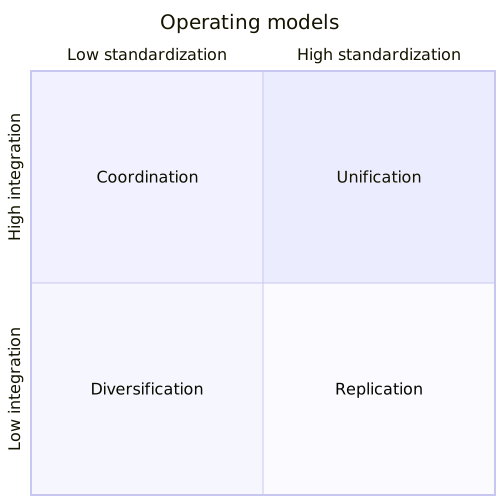
Diagram source
quadrantChart title Operating models x-axis Low standardization --> High standardization y-axis Low integration --> High integration quadrant-1 Unification quadrant-2 Coordination quadrant-3 Diversification quadrant-4 ReplicationChecks
Section titled “Checks”- The document states which operating model (diversification, coordination, replication or unification) the company follows.
- The architecture description is based on the company’s choices for process integration and standardization.
Related
Section titled “Related”- Operating Model
- Foundation for Execution
- Enterprise Architecture Maturity Stages
- Enterprise Architecture
- Enterprise Architecture Strategy
- TOGAF
- Zachman Framework
- Software Architecture
Sources
Section titled “Sources”- Enterprise Architecture: Driving Business Benefits from IT (selected research briefings) — dspace.mit.edu, accessed 2026-11-09
- Diversification, Coordination, Replication, and Unification | Microsoft Learn — learn.microsoft.com, accessed 2026-11-09
- MIT expert recaps 30-plus years of enterprise architecture | MIT Sloan — mitsloan.mit.edu, accessed 2026-11-09