Waves of Business Process Management
Explanation
Section titled “Explanation”Business process management has gone through distinct phases, each with its own ideas about how to improve work. The verified facts cover the early phase and one later landmark.
Early phase: reengineering. In 1990, Hammer published an article in the Harvard Business Review (HBR). It argued that managers should remove work that adds no value. Automating that work was the wrong move.
Hammer and Champy defined reengineering in 1993. Their definition: fundamentally rethink business processes and redesign them in a radical way.
Criticism. Reengineering drew sharp objections:
- Critics said many companies used it as a pretext for downsizing. The label BPR (business process reengineering) became tied to workforce reductions.
- Reported failure rates were high. One figure says 50-70% of projects either failed or brought no significant benefit.
- Davenport later judged that using reengineering for cost reduction alone was not a sensible goal.
A later landmark. Carr’s article “IT Doesn’t Matter” appeared in the May 2003 edition of the HBR.
Why this matters for architecture. Process models show how work flows through an organization. Hammer’s 1990 point still gives a useful check: ask whether a step adds value before you automate it. For how process work is organized, see the BPM Life Cycle article.
Example
Section titled “Example”A team plans to automate a monthly report. Before building anything, they ask who reads it. Nobody does. Following the 1990 argument, they drop the report instead of automating it. They automate only the steps that add value.
Trade-offs
Section titled “Trade-offs”Radical redesign can remove waste, but it carries risk. Reported failure rates were high, and the approach became linked with job cuts. Davenport’s later view was that cost reduction alone is not a sensible goal.
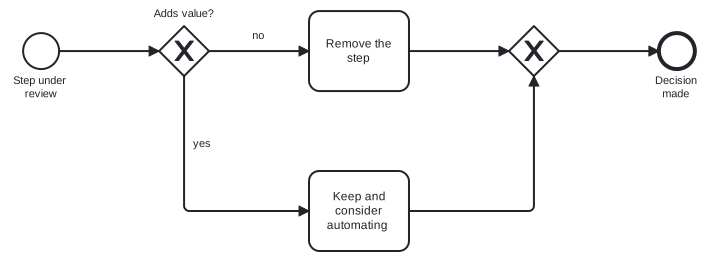
Diagram source
<?xml version="1.0" encoding="UTF-8"?><definitions xmlns="http://www.omg.org/spec/BPMN/20100524/MODEL" xmlns:bpmndi="http://www.omg.org/spec/BPMN/20100524/DI" xmlns:dc="http://www.omg.org/spec/DD/20100524/DC" xmlns:di="http://www.omg.org/spec/DD/20100524/DI" targetNamespace="http://example.org/bpm"> <process id="p1" isExecutable="false"> <startEvent id="s" name="Step under review"> <outgoing>f1</outgoing> </startEvent> <exclusiveGateway id="g1" name="Adds value?"> <incoming>f1</incoming> <outgoing>f2</outgoing> <outgoing>f3</outgoing> </exclusiveGateway> <task id="t1" name="Remove the step"> <incoming>f2</incoming> <outgoing>f4</outgoing> </task> <task id="t2" name="Keep and consider automating"> <incoming>f3</incoming> <outgoing>f5</outgoing> </task> <exclusiveGateway id="g2"> <incoming>f4</incoming> <incoming>f5</incoming> <outgoing>f6</outgoing> </exclusiveGateway> <endEvent id="e" name="Decision made"> <incoming>f6</incoming> </endEvent> <sequenceFlow id="f1" sourceRef="s" targetRef="g1" /> <sequenceFlow id="f2" name="no" sourceRef="g1" targetRef="t1" /> <sequenceFlow id="f3" name="yes" sourceRef="g1" targetRef="t2" /> <sequenceFlow id="f4" sourceRef="t1" targetRef="g2" /> <sequenceFlow id="f5" sourceRef="t2" targetRef="g2" /> <sequenceFlow id="f6" sourceRef="g2" targetRef="e" /> </process> <bpmndi:BPMNDiagram id="BPMNDiagram_p1"> <bpmndi:BPMNPlane id="BPMNPlane_p1" bpmnElement="p1"> <bpmndi:BPMNShape id="BPMNShape_s" bpmnElement="s"> <dc:Bounds x="80" y="102" width="36" height="36" /> <bpmndi:BPMNLabel> <dc:Bounds x="62" y="143" width="73" height="28" /> </bpmndi:BPMNLabel> </bpmndi:BPMNShape> <bpmndi:BPMNShape id="BPMNShape_g1" bpmnElement="g1" isMarkerVisible="true"> <dc:Bounds x="216" y="95" width="50" height="50" /> <bpmndi:BPMNLabel> <dc:Bounds x="201" y="76" width="80" height="14" /> </bpmndi:BPMNLabel> </bpmndi:BPMNShape> <bpmndi:BPMNShape id="BPMNShape_t1" bpmnElement="t1"> <dc:Bounds x="366" y="80" width="100" height="80" /> </bpmndi:BPMNShape> <bpmndi:BPMNShape id="BPMNShape_t2" bpmnElement="t2"> <dc:Bounds x="366" y="240" width="100" height="80" /> </bpmndi:BPMNShape> <bpmndi:BPMNShape id="BPMNShape_g2" bpmnElement="g2" isMarkerVisible="true"> <dc:Bounds x="566" y="95" width="50" height="50" /> </bpmndi:BPMNShape> <bpmndi:BPMNShape id="BPMNShape_e" bpmnElement="e"> <dc:Bounds x="716" y="102" width="36" height="36" /> <bpmndi:BPMNLabel> <dc:Bounds x="703" y="143" width="62" height="28" /> </bpmndi:BPMNLabel> </bpmndi:BPMNShape> <bpmndi:BPMNEdge id="BPMNEdge_f1" bpmnElement="f1"> <di:waypoint x="116" y="120" /> <di:waypoint x="216" y="120" /> </bpmndi:BPMNEdge> <bpmndi:BPMNEdge id="BPMNEdge_f2" bpmnElement="f2"> <di:waypoint x="266" y="120" /> <di:waypoint x="366" y="120" /> <bpmndi:BPMNLabel> <dc:Bounds x="307" y="98" width="18" height="14" /> </bpmndi:BPMNLabel> </bpmndi:BPMNEdge> <bpmndi:BPMNEdge id="BPMNEdge_f4" bpmnElement="f4"> <di:waypoint x="466" y="120" /> <di:waypoint x="566" y="120" /> </bpmndi:BPMNEdge> <bpmndi:BPMNEdge id="BPMNEdge_f6" bpmnElement="f6"> <di:waypoint x="616" y="120" /> <di:waypoint x="716" y="120" /> </bpmndi:BPMNEdge> <bpmndi:BPMNEdge id="BPMNEdge_f3" bpmnElement="f3"> <di:waypoint x="241" y="145" /> <di:waypoint x="241" y="280" /> <di:waypoint x="366" y="280" /> <bpmndi:BPMNLabel> <dc:Bounds x="246" y="206" width="25" height="14" /> </bpmndi:BPMNLabel> </bpmndi:BPMNEdge> <bpmndi:BPMNEdge id="BPMNEdge_f5" bpmnElement="f5"> <di:waypoint x="466" y="280" /> <di:waypoint x="591" y="280" /> <di:waypoint x="591" y="145" /> </bpmndi:BPMNEdge> </bpmndi:BPMNPlane> </bpmndi:BPMNDiagram></definitions>Related
Section titled “Related”- BPM Life Cycle
- Degrees of BPM Maturity
- History of BPMN
- Process Analysis
- Process Mining
- Process Automation Magnifies Efficiency
- Process Analysis and Modeling
- Enterprise Architecture
Sources
Section titled “Sources”- Business process re-engineering - Wikipedia — en.wikipedia.org, accessed 2026-11-09
- IT Doesn’t Matter | Nicholas Carr — nicholascarr.com, accessed 2026-11-09