Stakeholder Power Grid
Explanation
Section titled “Explanation”The stakeholder power grid is also called Mendelow’s Matrix or the power-interest matrix. Its earliest version is attributed to the researcher Aubrey Mendelow. In TOGAF, stakeholder management uses the grid. Phase A is where you identify the key players in the engagement. A stakeholder is anyone with a stake in the work (see the article Stakeholder).
How to build the grid
- Identify the main enterprise architecture stakeholders. This is the first task. The article Stakeholder Identification goes deeper.
- Assess each stakeholder’s power. This means judging their potential to affect the project, for better or for worse.
- Place each stakeholder on the grid by power and by interest.
- Use the position to decide how to engage and communicate.
What each position means
- High power, high interest (top right): These stakeholders care about the project and strongly shape its outcome. Manage them closely. The TOGAF-oriented guide calls them key players. You must fully engage them and work hard to satisfy them.
- High power, low interest: They are not interested right now. They can still greatly affect the project. Keep them satisfied.
- Low power, high interest: They care about the project but have little power over it. Keep them informed. Give them regular updates. Treat them as allies and early signals.
- Low power, low interest: The verified facts say nothing about this group, so this article gives no advice for it.
From grid to communication
Sending targeted information to the right stakeholders at the right time is a success factor. The grid output feeds a Communications Plan.
Example
Section titled “Example”A team plans to replace an internal ordering system. The architect lists the stakeholders and places them on the grid.
- The sales director has high power and high interest. The architect manages them closely.
- The finance director has high power but no current interest. The architect keeps them satisfied, because they could greatly affect the project.
- The customer support team has little power but high interest. The architect sends them regular updates and treats them as allies and early signals.
The architect then writes these choices into a Communications Plan.
Trade-offs
Section titled “Trade-offs”The grid is only as good as the judgments behind it. Power and interest are assessed by people, and a stakeholder’s interest can change. A group that is not interested now can still hurt the project, so the placement needs a second look from time to time. The facts here cover only three of the four quadrants.
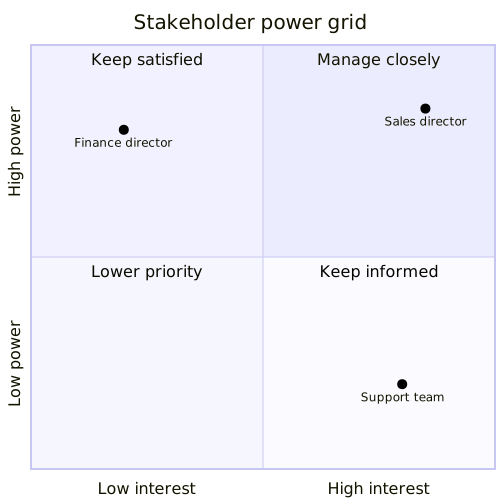
Diagram source
quadrantChart title Stakeholder power grid x-axis Low interest --> High interest y-axis Low power --> High power quadrant-1 Manage closely quadrant-2 Keep satisfied quadrant-3 Lower priority quadrant-4 Keep informed Sales director: [0.85, 0.85] Finance director: [0.2, 0.8] Support team: [0.8, 0.2]Checks
Section titled “Checks”- The main stakeholders are identified and listed.
- Each stakeholder’s power to affect the project, positively or negatively, is assessed.
- High-power, high-interest stakeholders are named as key players and engaged closely.
- High-power stakeholders with low interest are kept satisfied.
- A Communications Plan reflects the grid, with regular updates for low-power, high-interest stakeholders.
Related
Section titled “Related”- Stakeholder
- Stakeholder Identification
- Stakeholder Concern
- Stakeholder Readiness for Change Assessment
- TOGAF
- TOGAF Architecture Development Method
- RACI Matrix
- arc42 Introduction and Goals
Sources
Section titled “Sources”- Stakeholder Analysis for UX Projects - NN/G — nngroup.com, accessed 2026-11-09
- How to Perform Stakeholder Management in TOGAF? — visual-paradigm.com, accessed 2026-11-09
- Mendelow power-interest matrix - guide and worked example | Mutomorro — mutomorro.com, accessed 2026-11-09